1
StepSpread the baking soda in a thin layer on a foil-lined tray and bake at 150 C for 1 hour. It loses about a third of its weight and becomes sodium carbonate, which is a much stronger alkali. Cool it and store it in a sealed jar.
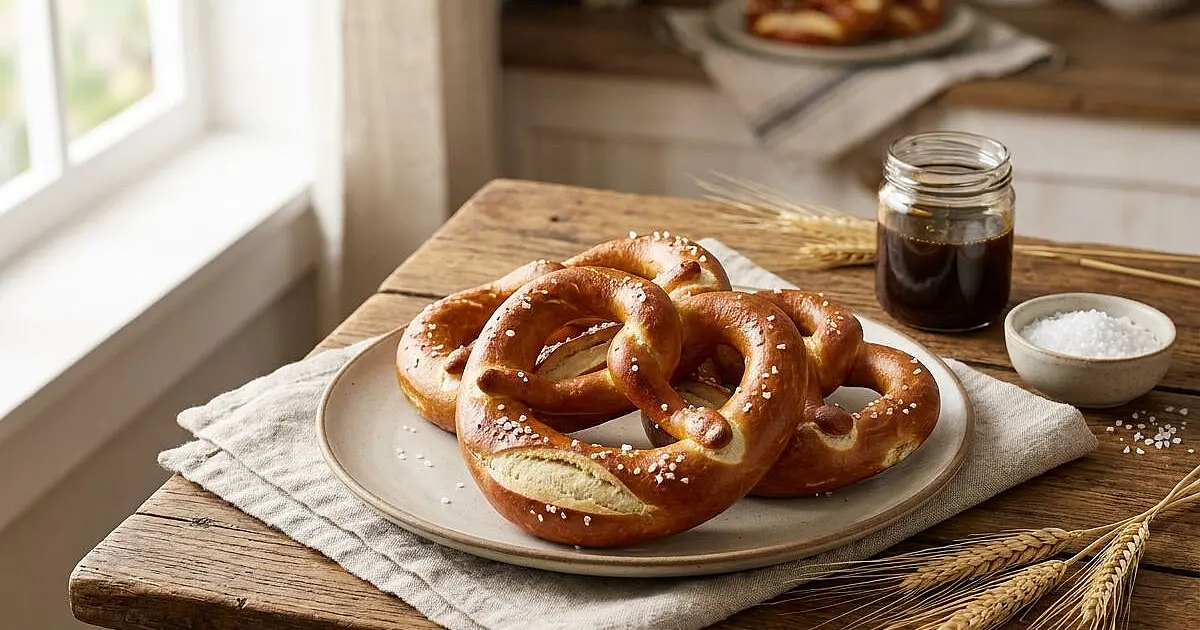
Proper Laugenbrezn with a mahogany crust, a dense chewy interior and the unmistakable alkaline tang. A dip in an alkaline bath before baking is what gives them their colour and flavour, and baked baking soda gets you most of the way there without food-grade lye. Best eaten within a few hours, split with butter.
This content is owned by the author and used with their consent.
Terms ↗8 Steps
Spread the baking soda in a thin layer on a foil-lined tray and bake at 150 C for 1 hour. It loses about a third of its weight and becomes sodium carbonate, which is a much stronger alkali. Cool it and store it in a sealed jar.
Mix the flour, yeast, salt, malt syrup, softened butter and water into a stiff dough, then knead for 8 to 10 minutes until it is smooth and springs back slowly when pressed. It should feel firmer and drier than bread dough.
Cover and prove for 1 hour at room temperature, until roughly one and a half times its size. It will not double, and that is correct.
Divide into 8 pieces of about 105 g. Roll each into a rope 55 cm long, thick in the middle and tapering to thin ends. Cross the ends twice and press them onto the fat belly of the loop. Rest the shaped pretzels uncovered on lined trays in the fridge for 30 minutes, until the surface feels dry and skinned over.
Wearing rubber gloves and eye protection, dissolve the baked baking soda in 2 litres of cold water in a stainless steel or glass pot, adding the powder to the water and not the other way round. Do not use an aluminium pot, the solution will corrode it.
Dip each pretzel in the solution for 20 to 30 seconds, turning once with a slotted spoon, then lift it out to drain and set it on a lined baking sheet. Do not touch the dipped pretzels with bare hands.
Slash the thick belly of each pretzel with a sharp blade at a shallow angle and sprinkle with pretzel salt. Bake at 220 C for 12 to 15 minutes, until deep reddish brown, almost the colour of chestnuts.
Cool on a rack for 10 minutes. Rinse the gloves, pot and any splashed surfaces with plenty of water before you sit down to eat.
Baking soda spread on foil and baked at 150 C for an hour turns into sodium carbonate, a far stronger alkali than the raw powder. Wear rubber gloves and eye protection, use a stainless steel or glass pot rather than aluminium, and keep it away from skin: it is much milder than lye but will still irritate.
Comments (3)
the shaping took me three attempts but they still tasted right
gloves, yes. i splashed a little and my fingers felt slippery for an hour
that slippery feeling is the alkali on your skin. rinse with plenty of water and a splash of vinegar and it stops.
baked baking soda is a revelation. proper colour and that pretzel smell finally